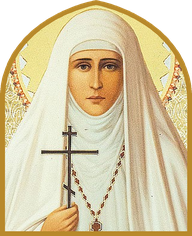
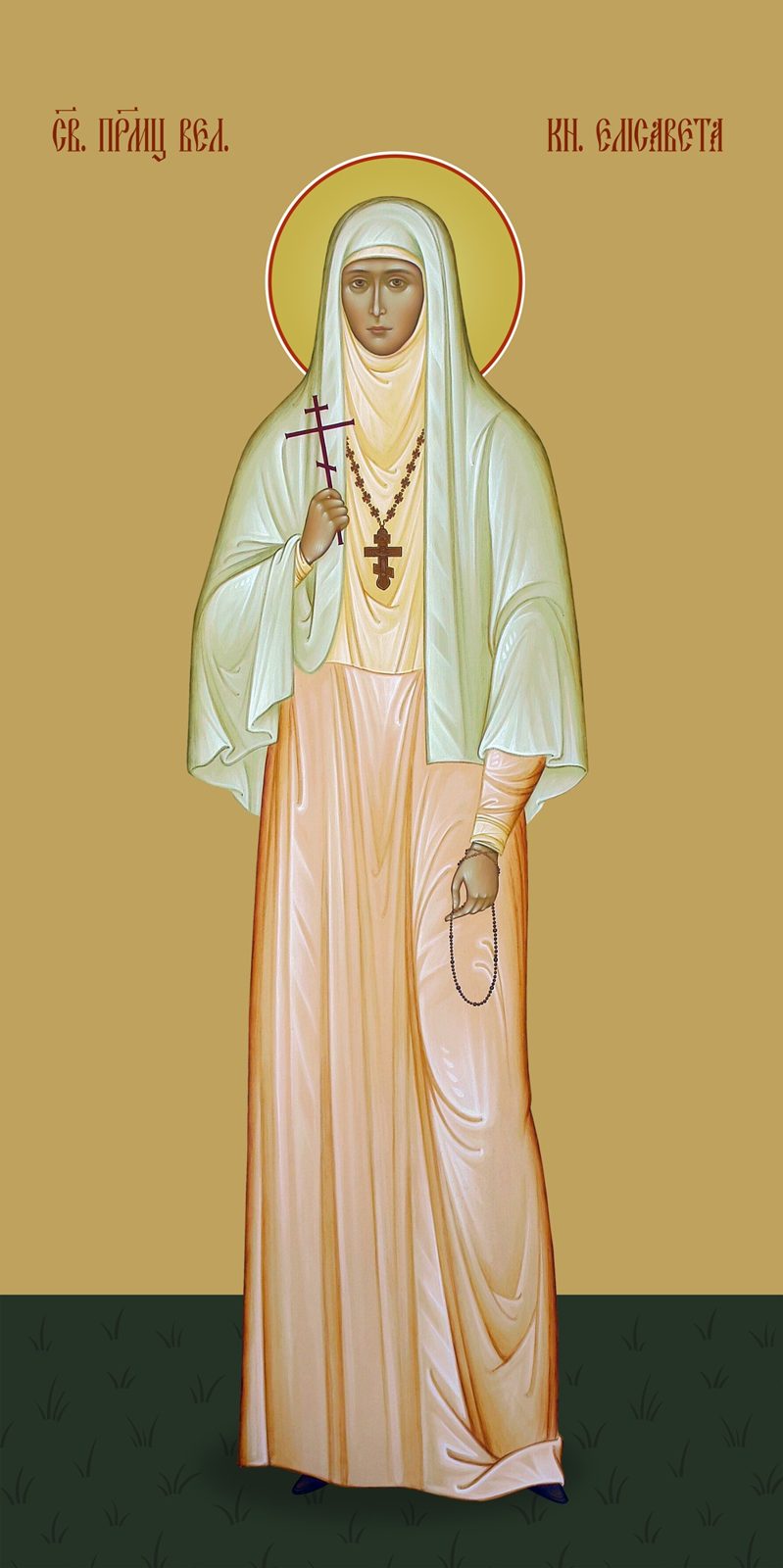
A childhood of love and sorrow
Elizabeth was born on November 1, 1864, in Darmstadt, Germany, a princess of Hesse and a granddaughter of Queen Victoria. She was raised in the Lutheran faith. Her mother, Princess Alice, often took the children with her to visit the sick and the poor, and Elizabeth learned early that faith is lived out in caring for others.
Sorrow came early too. Her little brother died in an accident in 1873. In 1878 diphtheria swept through the family, and her mother and youngest sister died within weeks of each other. Elizabeth, only fourteen, did what she could to comfort her father and her brothers and sisters.
A new home in Russia
In 1884, at nineteen, she married Grand Duke Sergei Alexandrovich, a son of Emperor Alexander II, and moved to Russia. Sergei was a man of deep and quiet faith. He never asked her to change her religion, but she came to love the Orthodox services she shared with him, and the Russian people.
In 1888 they traveled to the Holy Land for the consecration of the Church of St. Mary Magdalene on the Mount of Olives. Elizabeth was so moved that she said she would like to be buried there one day.
Choosing the Orthodox faith
In 1891, after years of prayer and study, Elizabeth was received into the Orthodox Church. It was a hard step: her family in Germany did not want it, and her father was deeply grieved. She wrote to him that it was not the beauty of the services that drew her, but the faith itself, and that she wanted to stand before God with a sincere and believing heart.
Her journey is close to many in our parish who were raised in other Christian traditions. She did not reject the faith of her childhood with bitterness. She followed Christ where she believed He was leading her.
Forgiveness
In February 1905 Grand Duke Sergei was killed by a revolutionary's bomb in the Kremlin. Elizabeth rushed to the scene and gathered what was left of him with her own hands.
A few days later she did something that astonished Russia: she went to the prison to visit the man who had killed her husband. She told him she forgave him, left him a Gospel book and an icon, and prayed that he would repent. She even asked the Emperor to spare his life.
A convent of mercy
After her husband's death Elizabeth left the life of the court. She sold her jewels and fine things and bought land in Moscow, where in 1909 she opened the Convent of Saints Martha and Mary. Like the two sisters in the Gospel, the sisters were to join active service (Martha) with prayer (Mary).
In 1910 she and the first sisters took their vows, and she became the convent's abbess. In their simple white habits, the sisters ran a hospital, a clinic, a pharmacy, an orphanage and a school. They went into the worst slums of Moscow to care for the sick, the hungry, widows and abandoned children. Elizabeth worked alongside them, nursing patients herself, and spent her nights in prayer.
Martyrdom
After the Revolution of 1917, many urged her to leave Russia. She refused to abandon her sisters and the people she served. In the spring of 1918 she was arrested and sent east to the Ural Mountains. Sister Barbara, one of her nuns, was offered her freedom but chose to stay with her.
On the night of July 17–18, 1918, near the town of Alapayevsk, Elizabeth, Sister Barbara and several members of the Romanov family were thrown alive into an abandoned mine shaft. It is told that she prayed for her killers in the words of Christ on the cross, "Father, forgive them, for they know not what they do" (Luke 23:34), that she bandaged the wounds of a young prince who had fallen beside her, and that hymns were heard rising from the mine.
Her rest in the Holy Land
Her body was recovered and, after a long journey across Siberia and China, was laid to rest in 1921 in the Church of St. Mary Magdalene in Jerusalem, the very church she had loved more than thirty years before. Sister Barbara rests beside her.
Elizabeth and Barbara were glorified as saints by the Russian Orthodox Church Outside of Russia in 1981 and by the Church in Russia in 1992.
Why she is our patron
St. Elizabeth's life speaks to the people who come through our doors. She found her way to the Orthodox Church as an adult, at real cost. She forgave the man who did her the greatest wrong. She gave away a palace's worth of wealth to care for the poor. And she remained faithful to the end, praying for those who killed her.
We celebrate her feast each year on July 18, and we pray to her at the Moleben to St. Elizabeth, a short service of prayer to our patron. Check the events page for the next one, or read the service in our service texts.
Further reading: the life of St. Elizabeth from the St. Elisabeth Convent in Minsk, a convent that also bears her name.